Wednesday, August 31, 2005

Hurricane Katrina


Hurricane Katrina, originally uploaded by Melinda.

Why are there "acts of God"?

So that we know of a God who acts.

"Acts of God" are not a punishment for people who sinned. For all people are sinners, there are none righteous.

And also not because some people in some parts of the world are greater sinners than others; for no sin is greater than another, and neither lesser too, but all sin are equally sinful.

God act, for people forget that it is God who is the Creator of all things.

We may plow the field, sow the seeds, but it is God who sent the rain and the sun at the right times to make the seed grow.

We strived to know so that we can better control the growth itself. We learn about climate and weather and biology and genetic science. We grow more and more in knowledge.

We know the best times and best places to plant, the best nutrient to feed the plants. We can now even engineer the best seeds for a particular geography and economic goal. We can tweaked a seed's genes to make it gives the best yields, the most resistance to pests, and the least tending, and so on.

But we still cannot make the rain fall and the sun shines as and when we want it.

Anyone who says that human knowledge will guarantees humankind certainty in all that we do, will be thought foolish.

And no man has yet caused any earthquake, or a hurrincane, or a tsunami, or a star to be born or die.

And yet we forget that what we do are only necessary for things to happen, but entirely insufficient.

Things happen only if God make them happen.

So "acts of God" is God speaking to the world that he is God.

And it is out of mercy that God keeps reminding the world that he is so.

That people die and people suffer lost are no argument that God is not merciful.

For all people die, one day. Only the manner, the timing, and one's readiness for it differ.

And people suffer lost everyday too at the hands of each other, but God is far kinder.

And David said ... "I am in a great strait: let us fall now into the hand of the LORD; for his mercies are great: and let me not fall into the hand of man."
[2 Sam 24:14]

Friday, August 26, 2005

Self Belief and Self Delusion

I was watching Arsenal vs Fulham and I heard the commentator mentioned that Arsenal is playing with a greater self-belief.

That started me thinking.

The commentators could have said Arsenal is now playing with more confidence, but it seems self-belief is the popular thing to say.

Also I thought that self-belief is another popular wisdom, namely it is something people want to and like to believe, for it sounds good, encouraging and optimistic.

And self-belief is used only for someone that believes something positive about themselves, and not something negative.

For example, no one would say Fulham have self-belief that they are going to lose, which they did of course. The objective of the game is to win and to believe you will lose is self-defeating and not self-believing. That's the English language. But rationally speaking what’s wrong with believing you will lose if you have reasons to believe so?

My aversion to the popular notion of self belief is that it can be easily muddled to become self-delusion, i.e. think and believe you can do it and you can and will do it; think success and you will succeed.

I think this is a lie.

You may immediately react to this and reject me as negative and pessimistic.

But what I am saying is that if self-belief is mere unjustified and unsubstantiated belief about yourself and your abilities, then it is irrational, foolish and potential dangerous too.

On the other hand you should be confident, optimistic and bold when you know, or some reasons to believe, that you are able to do something and accomplish it successfully.

I am not objecting to self-belief per se but rather the reasons for so believing or the lack thereof.

But you may say you don’t need to have reasons you only need to feel so. Then I say again, by definition, such a state is irrational, and borders on the mystical, and gives no grounds for being confident, one way or another.

I then did some research on the Internet.

There are indeed the popular notions that I suspect are out there:

For example from here, we have this: "To achieve any goal in life, you must believe you are going to be successful. If you do not, you are likely to fail."

And from here, we have, "Approaching new goals or challenges with a healthy mindset is crucial to achieving the results you strive for."

On the other hand, there is a well-written and rational analysis of self-belief in Wikipedia, here. The notion of self-belief is refined by the concept of self-efficacy, i.e. the ability to accomplish a thing with one own self, or as defined in Wikipedia, as "people’s perception of their ability to plan and take action to reach a particular goal."

We can think of a 2x2 matrix, with accurate and inaccurate perception on one axis, and able and unable on the other side.

One obvious concern area in real life is of course when your self-perception is inaccurate. If you are able but perceived otherwise, then you are shortchanging yourself. On the other hand if you are unable but perceived you are, then you may jeopardized yourself, i.e. you may try to bite off something more than you can chew.

And the answer to attaining accurate perceptions is to have mirrors, mostly other people, people who know you and whose judgments you can trust, as in the do not have ulterior motives telling you what they see.

There is also a link to an academic study of perceptions of self-efficacies with culture by the Freie Universität Berlin. You may be surprised but it seems that the Japanese and the Hong Kong Chinese have the lowest sense of self-efficacy when compared to Western cultures. Maybe the problem is in the way self-efficacy is measured.

I have copied here the ten questions used to assess self-efficacy:

1. I can always manage to solve difficult problems if I try hard enough.

2. If someone opposes me, I can find means and ways to get what I want.

3. It is easy for me to stick to my aims and accomplish my goals.

4. I am confident that I could deal efficiently with unexpected events.

5. Thanks to my resourcefulness, I know how to handle unforeseen situations.

6. I can solve most problems if I invest the necessary effort.

7. I can remain calm when facing difficulties because I can rely on my coping abilities.

8. When I am confronted with a problem, I can usually find several solutions.

9. If I am in trouble, I can usually think of something to do.

10. No matter what comes my way, I'm usually able to handle it.

They sound very much like gut feelings and 'beliefs' about and ‘faith’ in yourself, i.e. the answers to these questions may not necessarily be reasonable or justified in your true abilities. For example you may say yes to the question that you can always get out of trouble, but in reality and in your historical track record it may not be so.

So it may be pseudo science after all.

But in any case self-perceptions of own abilities, or lack thereof, don’t really matter, unless there are some particular and desirable goal or goals to be reached. (Or when, because of your self-perceptions, you have no desire for some necessary and critical goals.)

And then it matters when there is a mismatch between your abilities, however perceived, and the desired goals. What these goals should be is another matter, but assuming that the goals are rightly desirable, then the question now is what do you do if you perceived yourself as inadequate to attain it on your own?

Then to persist by the sheer ‘self-belief’- either positively, i.e. I can do it no matter what, or negatively, i.e. I wont even think about it - is what self-delusion is all about.

Wednesday, August 24, 2005

Everything is Meaningless

There was a man
who wanted a thing badly for some time.
Then he got what he wanted.

But when he got it,
it was not what he wanted.
For what he had craved for, in his mind,
was different from what the real world is.

And then there was another man
who wanted a thing just as desperately.
But after some time
he forgot what he wanted,
and life still goes on,
without the thing he thought he cannot live without.
For what he thought, in his mind,
that he must have,
was not true.


And then there was the man
who rejected a good thing that was given to him.
He didnt seeked nor asked for this thing.
He didnt want this free thing
when it was given to him unexpectedly.
There can be many reasons why he didnt want it.
Maybe he have no need for the thing,
the good and bad thus being irrelevant.
Maybe he didnt know he needed that good thing.
But maybe he knew,
but he rather not have a good thing,
but prefers a bad thing instead.
He relished in his freedom
to choose the bad and to reject the good.

Then there was another man
who accepted the bad things that comes his way,
and did not reject them.
Again there can be many reasons.
He may not know it is a bad thing.
Or again he may have known,
but like the bad instead.
Or maybe he just cannot
or do not want to choose -

for reasons such as,
dont want to think,
no time,
takes too much effort, etc -
and takes whatever that comes his way,
good or bad.
So he may be tired of choosing
but rather just let "Nature takes its course".

So what we think we want,
may not be the thing we get,
no matter what we do;
and the things that we get,
no matter we seek them or not,
may not be the things we want.

And whether we know it or not,
we can seek bad desperately,
and reject the good given freely;
or we may think we seek and accept the good,
but what we get may be the bad instead.


So everything is meaningless.

----------------

"Utterly meaningless!
Everything is meaningless."
Solomon, Eccl 1:2

Tuesday, August 23, 2005

On Wasting Time

Teck: Last night someone told me I was wasting my time in the chatroom.

Seng: So? What's new? I just had a terribly boring, utterly time-wasting meeting in the office today. So you tell me about time wasting.

Teck: I rather see it as an exchange: our time for money. And so no matter what we didnt waste our time.

Seng: But surely there are better things to do with our time, don't we?

Teck: Ya, but we cant do these better things without money can you?

Seng: If there are indeed better things to do. Anyway back to your chatroom, was it not ironic?

Teck: What do you mean?

Seng: Well wasn't he himself in the chatroom? Wasn't he wasting his own time too? If he really believed what he said, he should heed his own advice and never be around to chat with you.

Teck: No, not really.

Seng: How so?

Teck: Have you yourself not said that it is not what you do that matters, but rather why you do what you do. Different people have different reasons for being in the chatroom. It's your ends and means that determine whether you are wasting your time or not.

Seng: Well, well, since when have you thought and talked like this?

Teck: Since mixing around with the wrong company I suppose.

Seng: Ha! Ha! Ha! Well I am glad that at least you remembered some of the things I've said. I am also glad you are thinking more rationally and not just being emotionally reactive.

Teck: And you have to learn to be more emotionally reactive.

Seng: OK. Agreed. We are all deficient in one way or another. I need to mix around more with the right company then. So what then were your reasons - your ends and means - for being in the chatroom? Did you waste your time last night or not?

Teck: Was looking for fun.

Seng: And?

Teck: And had fun.

Seng: So?

Teck: So what?

Seng: So was it time well spent or time wasted?

Teck: I cannot say I wasted my time.

Seng: Hmmm. Then the means was effective. And that's how usually people assessed whether they are wasting their time or not: namely whether they get what they wanted, for the time and effort spent.

Teck: Yup.

Seng: But what of the ends? What makes spending time and effort pursuing one thing less wasteful than another thing? What makes doing this thing better than doing that thing?

Teck: There you go again. Thinking too much again. People just know what they want. They don't question them. When you are hungry you go look for food. You don't think about it.

Seng: It may well be so. But then we are more than mere animals. Humans are not just biological things, driven by instincts, or by our physiological wirings and our psychological makeup. We can and ought to be driven too by reasons and rationale, truth and beauty, hope and love, righteousness and justice, amongst other things.

Teck: Whatever. We have to eat we have to eat. You can't live on truth and beauty. Feed on love and fresh air and you will starve and die. And when you are dead and gone, righteousness and justice are irrelevant and meaningless.

Seng: Wow! You really have grown in your thoughts. It is a good argument and I will pursue it further. But immediately, tell me, did you really get what you wanted last night? Was the fun really fun?

Teck: You wont know if you never try.

Seng: But this is not the first time. You have tried many times in the past too. And you are still trying.

Teck: Yes, but that's all you have going for you: to try and try again.

Seng: I don't think that's the only way to look at it. The thing you seek may not be what you think it is, and you end up chasing after a mirage or an illusion.

Teck: Like mistaking a shadow for the real thing?

Seng: Yes, precisely. And we know you can never catch a shadow. You can try and try for all your life and you will get nothing. Such a chase is the ultimate time wasting: your entire life wasted in futility.

Teck: That was what we chatting last night too in the chatroom. I was telling him to give up waiting for the person who left him, and even now considers him an enemy. He is wasting his life away hoping that the person returns.

Seng: But what's the difference? He waits, and it is futile; you chase, and isn't it futile too? You are both wasting your time.

Teck: If you wait, nothing happens and nothing is changed. I act, and I am constantly creating chances, discovering new things, people and opportunities all the time. At least I have have hope that tomorrow can be a different day.

Seng: I still don't see the difference.

Teck: Why not?

Seng: Do you really think you are improving your chances for whatever you want by acting? And that by your inaction nothing changes? Surely the world don't wait for you to act to change. When I go to sleep at night, the other half of the world is full of events and activities, and when I wake up tomorrow, indeed the whole world is a changed world. And what you do may tantamounts to no more than chasing after the wind, and wont change an iota in the real world.

Teck: OK. OK. So we may be both after shadows. He waits for the shadow to come to him. I may be going after a shadow too. But how else can I know? By acting at least I may know better.

Seng: That is presuming he who waits does not know and have not learnt, and that you, on the other hand, have not learnt, and are willing to learn. But the lesson may already be available for the learning.

Teck: You are suggesting I am not learning?

Seng: Yes.

Teck: I have this thing against you.

Seng: What?

Teck: Why must you say things so unpleasantly and so negatively? Can't you say things differently and not make me feel so put down? Can't you say things positively and not make me feel hurt and to lower my self-esteem and confidence?

Seng: You rather I flatter you instead? I think it's a far grevious wrong - for both parties - to tell someone he is alright when he is not. Truth hurts because it was avoided in the first place, and truth hurts to wake you up from your delusion.

Teck: I know you are a stickler for truth and precision, but that's no reason for you to be rude and insensitive to others. What makes you think they want to hear you in the first place? And they may not be ready for it, and it does not help them to know it anyway. And then, when and if I want to know these truths, there are surely others more pleasant, who too can see and tell me the same things.

Seng: We are back to where we started. This is yet another instance of not what we do that matters but why we do it.

Teck: Ya, but you may have all the good intentions for me, but if I reject you, because I find you unpleasant, then all your good intentions comes to nothing, and you have wasted your time.

Seng: Can you not see beyond the superficial and the apparent, and know for sure what is real, which is silent and unseen? And again from what you just said, your values are very skewed and distorted. Do you think it is a fair trade, trading away what you called 'good intentions' for mere pleasantries? You rather someone be nice to you than true to you?

Teck: Hey this is a free market. I can choose. And I will choose the one who is nice and true.

Seng: So it seems. But that is just popular wisdom. And some people need experience - and to be able to learn from these - that popular wisdom is usually a fallacy. So then have you learnt anything from the real world? Is love really a free market? Can you shop and choose and trade yourself for someone to love you? Is this is fact of fiction?

Teck: I will soon know it.

Seng: Aren't you being presumptuous yourself here too? If you have to choose only between nice or true, how would you choose?

Teck: I am not interested in these hypothetical questions. I know what I want. Surely in the mass of people that I will meet in our lifetime there will be at least one who is nice and true. I just need to meet more people and more frequently. That's all to it.

Seng: And that you have been doing. But for how long? You may say you know when you have got what you want. If so, and assuming you know what you want, when will you call it a day, and say enough is enough? If you search for something, you too must know when to stop the search and accept that you cannot find it. And this may be either because it is not there, or you just cannot find it.

Teck: When I run out of resources - time and energy - or when some other substitute comes along. The substitutes may be imperfect but it is still closest at that moment to what I seek.

Seng: Like settling for polished shining iron, that will rust one day, instead of working to extract the gold from an ugly gold ore, but which will last forever?

Teck: I didn’t say that. Why should I reject an ore of gold? It is only that I have not found that nugget. And what makes you think that I am searching for anything at all in the first place?

Seng: I thought that it's you who is seeking for the one who is nice and true, and that you have to meet more people more often to achieve your goal. You didn’t say that?

Teck: If I am searching for the one nice and true. But for now I may not be searching, but only seeking fun. That's all.

Seng: And are you not wasting time then?

Teck: I have my fun. I don't ask questions I can’t answer. If there is something better and I do not know it, then it is moot to me. I can only see what’s best from what I know.

Seng: And from what you know fun is what is best for you?

Teck: Yes.

Seng: And that is why I say you are not learning, not because you are unable, but you are unwilling. Like you have said, you are not a child, and you are not an idiot.

But learning is only possible if you allow yourself to learn. And it is not like what you do in school, which is all head knowledge to be regurgitated in the exams. Rather learning is change and life changing. To learn you must be willing, and thus able, to see the world in different perspectives, and to act differently based on these new and fresh insights. If you don’t act it is as good as you not having learnt. And when you act you change.

You must be willing to accept facts, no matter how painful or 'rude' they may appear to you, and be disciplined to discriminate truths from falsehoods. Learning is not a one-way street, a filling of an empty vessel, but rather a two-way dynamic interaction between living entities, and the process changes both parties.

No amount of experience tantamount to anything if you are unwilling to learn. On the other hand, for someone already learning, he can even learn vicariously, ie from someone else' experiences. And that is how we learn from history.

But history repeats itself; because people are very prideful, such as thinking that they cannot be as dumb as their predecessors, or they prefer to hear what they want to hear, like they are free to choose, and refuses or are not willing to learn from it.

And so people experienced the same things over and over again, in continual futility. And it is just like you in your past, and in your present situation.

Every ONS is the same, the same emptiness, the same meaninglessness, and the same so-called fun. But yet you repeat it over and over again, refusing to acknowledge that no amount of sex or how skillful or fun it was, it can never be great sex. For sex is a shadow it is not the real thing. And sex is meaningful and great only with someone you love. And just holding hands with someone you love can be great sex too.

So if someone tells me he needs to try and try, and each time failing, I will be immediately suspicious that something fundamentally is amiss, and the real reason is to be looked for elsewhere and not in the trying.

Thursday, July 07, 2005

What is Sex?

It will be generally agreed that the following are sexual acts on a decreasing scale of sexuality:
  • anal penetration (and/or vaginal penetration in the case of straight sex)
  • blowjobs
  • mutual handjobs
  • hugging in the nude
  • hugging not in the nude
  • hands-holding
  • looking into each other's eyes
  • masturbation
  • fantasising
(Kissing is somehow difficult to fit into this continuum. In an ONS parties would rather be penetrated than kissed.)

Now somewhere along this continuum these acts become sex; but where this happened is seemingly a long unanswered question, from what I have read and heard.

There are possibly three categories of people in this respect.
  • only penile penetration to be sex, anything else is merely 'foreplay'.
  • any form of genital contact, with any other part of the body - yours or another's - through the clothes or in the nude, is sex.
  • finally at the other extreme there are those who would consider even looking into the eyes as sex. And to think about sex is also sex.
But then is a doctor fondling your testicles to check for testicular cancer or fingering you to check your prostate, sex? And also it is certainly not sex if a nurse - even a gay handsome hunky male one - is to see you in the nude, and you get an erection thus being seen, although you may wished it is. And what if your male office colleague, whom you have a crush, accidentally brushed against your crotch, or you brushing his, and you felt his shape, size and position underneath? That is not sex too, although you may exploit the opportunity and let your hand linger a little longer than justified as accidental.

We must then conclude then, that sex is not entirely physical, ie it not merely physical acts. The motives or intentions behind such acts do matter too. So sex is not merely what you do, but also, if not entirely, why you do, ie you can apparently be having lunch with someone but because of what you both have in mind of each other, you both are actually having sex instead of lunch.

Sex is thus some sort of physical act - which may or may not involved the genitals - but more importantly, for which deliberate sexual arousal or pleasure is desired or intended.

And thus my view of sex is this: sex is the physical expression of love.

But I beg the question.

For what is love? and what if it is a physical expression of lust instead? And surely lusty sex is more sexy and sexual than merely love can ever arouse. And also what is the difference between love and lust?

Now, of course, there is love and there is love.

There is the love of your parents, your parents' love of their children, love between siblings, friends and neighbours, the love for your pets, your job, your cars, etc etc. And then there is the love between lovers.

So is the physical expression of love between parents and children, or between siblings sex? Most will, without hesitation, say no. But then there are such things as incest too.

And certainly it is also not sex when you expressed love for inanimate objects like your car and your hobbies (or your dildos), or to non-humans, like your cat or dog. It is also clear that bestiality is another topic, and is another type of 'sex' altogether.

Then what about physical expression of love between friends, such as handshakes, hugs and even kisses? Is it sex? Well things can become grey here I suppose, but to a larger extent they are non-erotic, ie does not and not intended to evoke sexual arousal and therefore not sex (but this is really a little circular argument).

So we are left with only the expression of love between lovers. Now what is this love that is different from all the other kinds of love?

And here I will introduce another concept, namely that of Eros: the love between parts of the same; the emotions, the sensations, the feelings, when two persons are made complete in each other. And Eros is that which propels people to seek their other part (or parts?) to complete each other.

Eros is the love one has for the flesh of your flesh, the bone of your bone, between one of the same soul.

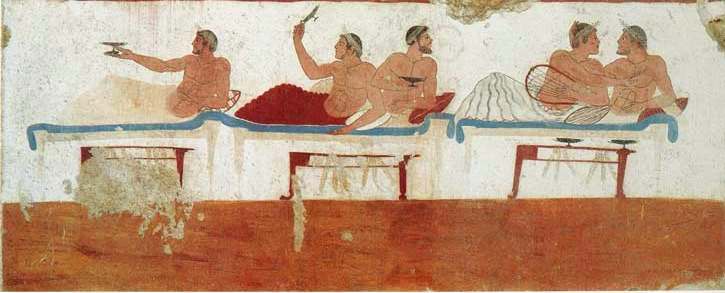
Such a notion is not only implied and present in the bible - namely that between Adam and Eve, David and Jonathan, and also, some have argued, between Naomi and Ruth - but also articulated by Plato in one of his dialogue - Symposium - in which a speaker by the name of Aristophanes expounded this concept. Here Eros is the desire to regain wholeness, a wholeness that existed in the beginning, and the desire to be merged with the other to become whole.

A fresco taken from the north wall of the Tomb of the Diver
featuring an image of a symposium


And thus sex is the physical expression of such a love, namely Eros.

It sounds like I am stating the obvious, but it is not, for now we can make a distinction between Love and Lust, and perhaps also between 'sinless' sex and 'sinful' sex.

Lovers' love is that arising from true Eros, ie between two people that belongs to each other.

Lust on the other hand is the desire for the physical pleasures of genital stimulation, as aroused physically by the thoughts, sight, smell, touch, taste, etc of genitalia or other parts of the body, of your own, or of others, of human or otherwise, or even of inaminate objects like shoes, shorts, socks, etc, or psychologically, such as being in a position of vulnerability or surrender, or conversely of domination and of ownership, and thus you have S&M. Such stimulation do not need Eros to be stimulating. And thus you can lust and have sex with strangers and people you don't know. But these people must be of your 'types' physically or psychologically.

'Sinless' sex is the physical expression of pure genuine Eros, and sinful sex anything else.

But Eros, like everything good, is corruptible, and you may, if you are cynical, say, thoroughly corrupted too these days. And Eros corrupted is a desire to make your own what is not yours or what you think is yours. And examples of sex arising from corrupted Eros are such as rape, incest, molest, etc.

Now, if you think about it, Eros actually is gender-neutral.

It is merely the love between parts that 'belongs' to each other. The gender of these parts is merely incidental.

And also, if you think further, in an ironic twist, Eros really has nothing to do with sex. It is the sinful corruption of the world that have associated it with everything erotic and sexual.

For Eros need not be expressed physically at all. It is merely that which is the reason for the unity and oneness of parts. Whether such a oneness is expressed or not, does not change the fact of the unity and of the Eros that exist between these parts. And Eros can be expressed in ways other than physical too. The awareness of being of one mind, of one spirit, and acting as one man with the same purpose are also expressions of Eros.

Physical expression or sex is thus not necessary. It is also inadequate for the fullest expression of this oneness we feel for another. For as long as we are in this physical body, no amount of 'physical expression' can really unite us to another, even if we are biologically made for it, as between male and female. Life as it is will not allow us to be constantly together physically. And then one day we all die. Thus the only true union, or rather reunion, is in the spiritual realm, and we can be apart in space, and even in time, and in body, and yet be of one spirit, eternally.

And finally, kissing: To me it is perhaps the most sublime physical expression of two souls being one.

Friday, July 01, 2005

Appearances

From a letter ...
I wanted to conclude our chat last night.

I think it is good that you know what is reality.

I just want to add that it is also reality that you cant 'force' love.

It is also reality that gay relationship often starts in the heat of lust, and is sustained for a while by that same lust, and then reality sets in.

Some confront the reality and call a spade a spade, and both parties acknowledge the lust and call it a day, with no regrets or hangups, each go away having enjoyed the sex.

Others, perhaps overcome by guilt, or some unreasoned value or belief system, try to make it work, with or without acknowledging the initial lust as lust.

Some still continue to pretend it was 'love'. And in these cases people try to make love, in the real sense of the word, but then love cannot be made or forced.

The so-called love that is created is artificial,fake and unnatural, again in the very real sense of the word.

And so the parties hang on to the relationship on pure committment in the worst case - the fire in sex no longer burns, and if it still does, don't drive the relationship as it did intially.

And this is the nature of physical stuff. Just as food: once satiated the choicest food is no longer appealing.

And committment is literally a committment to keep up pretences.

Well true love may indeed happened in such a process of 'working it out'.

But then the chances are no different from starting anew with some stranger, for that's what the parties were, all along, even from the beginning: strangers.

And the sex, called it what you like, is still an ONS, and extended one albeit.

So gay relationships are unnatural in the sense that it is founded on a mirage, an unsustainable foundation. Whereas any relationship founded on true love, is natural and true, regardless of gender.

But then such love cannot be searched for nor created.

It is something that is given to us, from what I know, by God; and it is something that looks for you and not you to look for it.

For what you looked for can only be something you are aware of and think or know about.

But love is not something you have known until you are there. So if you looked for it and found it, it is most likely, ironically, not what you seek.

Just my thoughts ... There are more, but thats for another time ... Bye

Life's for Life

A seed lies buried, unseen, and unknown, in an desert whose sands no human foot have walked. It have been buried for ages in the hot dry sands of this forsaken place on earth.

Then came a brief thunderstorm.

It happens only once in many many years. And suddenly a flood innudates the desert.

And the seed came to life.

And frantically the seed takes root, shoots and blooms.

And not too soon.

For the flood soon subsided, the water soaked into the very thirsty dry sand, disappearing deep and fast underneath. And it is unimaginable that there was a flood just hours ago, but for the extensive field of flowers now blooming, which, even with satellite imaging, no eyes have seen.

And the sun is shining, bright, very brightly and very hot.

And the flower, its beauty seen by no human eyes, its fragrance and scent a mystery to the human race, its species unknown to science, has begun to die from the very moment it came to life.

But from apparently nowhere comes flies, beetles and ants, busy seeking the sweet food in the flowers and fertilising them in return. And by the time the sun is high the sky, the flowers are already wilting.

But the flowers have fulfilled their purpose for life. They have justified their reason for coming into being. The have created the next generation. Their seeds are fertilised. Now they are ready to die.

Come evening and the field of flowers is all but a brown mess. When the sun rises the next day, it is a desert once again, as it has been for ages, giving no suspicions of the life hidden under its lifeless sands.

But the buried seeds, the hidden life of the next generation, await, patiently, for as long as it takes, for the next thunderstorm at some unknown long future.

What is the meaning of all this?

And again what about the insect who spend months or even years in the water, or in the ground, undergoing a slow convoluted metamorphosis to become a winged insect, but only to live a week in the air, or in the tree.

And in that week it has one goal and purpose only: to mate and to mate and to mate, even every moment of its brief sex-crazed life. And then it dies. For the female it lived a while longer, just to lay its eggs, which will start the meaningless cycle all over again and perpetuating itself endlessly.

Again what is the meaning of all this?

Is this what life is about? Is life just to continue life in endless and meaningless cycles?

And we see the same thing in human lives too. All the things we do as a child and in school is to learn how to earn a living, to feed and house ourselves, and to start a family of our own.

And not that it is a bad thing; in fact it is a very good thing.

For there are such as love and sex and marriage, that give sense and meaning and an ecstacy unexperienced and unknown elsewhere in any relationship.

And then there are children. They are joy, pain, turmoil, delight, sadness and happiness all bundled into one. And raising children is so consuming that you may never have time to ask the question, what is life. Even if you do, the very question may seem meaningless and irrelevant, when you are in the midst of your happy family.

Indeed life's for life!

For is it not true, that the greatest blessing anyone can give is to give life to another being?

And such a blessing is far greater than to bless by not destroying or to preserve an existing life. And everyone is blessed with this blessing to create life!

But then this simple, natural and instinctive behaviour is not accessible and available for all. For some are born handicapped, physically or psychologically; and unlike life's propagation in the other biological species, the human process is apparently flawed. For non biological factors, like the human spirit, lusts, desires, and other longings and yearnings, interfere with the process, and as a result, you have marriage breaking up, adulterous affairs, and people just avoiding marriage altogether. Is there such a thing as adultery in the animal world? No, only humans committ adultery.

And so is life indeed for life, when there are some who cannot participate in this cycle?

We can make two conclusions.

The first is, it is just too bad, if you are precluded from this natural happy cycle. And some may explain this by evolution or some by religion, like sins in past lives, or whatever countless theories.

But whatever is said, my soul cries out against such 'explanations'. They all do not speak to my soul. They are all unjust and unjustifiable. Deep within me, my soul refuses to be pacified or consoled. I am inconsolable and unjustified, and I cry for justice.

The second however is the more natural and obvious conclusion, ie life's not just for life, and we must conclude that there must be more to life than mere life.

But what is this? What can life be if not for life itself? What's life beyond life?

If we are but another biological species, there is nothing much to argue for life beyond life. As the birds and the bees and the chimps do, so do humans.

But then we are not merely animals nor just the mindless outcome of impersonal biology, are we?

One Life

You want to be free, but you become a slave.
You want happiness, but you suffer without knowing if you get it.
You want life, but you have to give it away.
You want purpose and meaning in life, but everything is meaningless.

The monkey plays in his food, the fish swims in it,
Cats and dogs get fed by being cute,
And sparrows grow fat and numerous,
And no one knows how.

But humans must work just to get money.
We sell ourselves to exchange for money
We call boss anyone who controls our money
But when we get the money, it is not enough.

And when we reached the end,
We realised we sold everything,
And have no more time to spend the money,
To buy the freedom and the life we wanted.

And everyone walks the same road of life
We can see it is a dead end,
But the young will not listen, they have hope,
And the old got nothing to offer, they have no hope.

The happiest creatures are the animals, who did not look for it
They are born, eat, grow up, have sex, and make babies, and die
And the next generation follow after them,
an endless cycle, that is life.

Wednesday, June 22, 2005

On Thinking

There is time to think
And there is a time not to think
There is time when there is too much to think
But, I think, never a time when we think too much

Thinking can be hard
Thinking can be easy
Thinking can be right
Thinking can be wrong

Sometimes we think and get it wrong
Sometimes we feel and get it right
And both times we may not know why
But if we do, we think and feel better the next time.

But be it thoughts or be it feelings
What truly matters is knowledge
And we need both thoughts and intuition
To know the truth.

Tuesday, June 21, 2005

Life's Irony

A man was sick, very sick.

He was hospitalised and was in intensive care for 2 months. The most advanced medical treatment was given to him, and a wide array of deep medical expertise consulted from far and wide all over the world. The man recovered and was discharged after another 2 months of hospitalisation.

Then he was hit with the bills.

He had lost his job before he was hospitalised. He was not easily employable. There was no balance in his savings account and what can be paid by public funds have all been paid. And yet a huge balance remains. The hospital threatened and sued him and he declared himself bankrupt.

He had no family. And he had no friends. For he often borrowed and no one wants to know him anymore.

He was miserable.

He committed suicide.

The so-called "Long Term Relationship" in Gay Parlance

Posted elsewhere and edited for posting here ...
Long Term Relationsip or more commonly known by their initials LTR, is something, apparently, the most sought after kind of relationship that gays are pursuing. But is it really so?

People come into a relationship for three, or maybe four, reasons.

First, perhaps the most common reason, especially for gays, is really just sex, plain and simple.

However many will deny this is the reason. The evidence, on the other hand, is more compelling that anything you or anyone say. And thus I have concluded that the so-called LTR is merely an excuse for sex, and love was used, or abused, as a justification for lust.

And the evidence is simply this: the many stories of so-called gay LTR that dont last long, lasting from weeks to months and at most a couple of years. And even then in the latter most of time it has degenerated into a so-called 'open relationship'.

For sex is all about lust, and it is all about physical attraction and physical sensations, and such relationships founded entirely or mainly on such cannot last. I know, for I experienced such lusts first hand myself too, as I am sure many do also. After you have discovered someone, seen him naked, eaten his fruits, he no longer excites.

So strictly speaking such relationships are just extended ONS or sex-buddies.

The more interesting thing to do here is not to debate the fact but rather to ponder and speculate the reasons why people are averse to calling a spade a spade, ie to say openly that what they want in a relationship is sex. I can think of a few reasons.

One is the notion that ONS is bad. I have seen this sentiment expressed, some from religious perspectives, be it Buddhism or Christianity, but no one really asked themselves why it is so. Maybe it is just a hangover from the notions and values of traditional straight relationships where you are not suppose to screw your gal before you marry her. So sex outside of a 'marriage' is bad. And so people seeking sex, seek a so-called LTR, to be a cover to justify having sex, particularly that involving anal penetration in the case of gays.

And here I want to relate an incident. I was horny and met this guy. And we were proceeding beyond hand-holding, and into the process of comprehensive mutual discovery, but he hesitated saying that he will have sex only in a relationship. But then he has crossed the point of no return, and so he made up his mind on the spot that we are already in a relationship, ie to consider me already a boyfriend after only a few hours knowing me. But that was what he needed pscyhologically to go on to enjoy the physical. And after this point he abandon himself fully to the thrills, and it was the first time I walked on the beach naked hand in hand with another one naked.

I have also observed that usually it is bottoms who seek such LTR. Tops generally have less qualms about calling ONS, ONS. I may be wrong, but I think it is reasonable; and the reasons are, it is safer to stick to one cock; a cock is a cock, ie it does matter if it is the same cock, the thrill of your G-spot being hit is still as thrilling; and it is perceived it is ok for tops to have ONS but for btms to get fucked around is to be a slut.

So tops are not thought 'immoral' to have ONS, and thus tops give full rein to their thrill of 'discovering' people, many many people: a new face, a new bod, a new cock, a new ass, alway excites more the same old asshole. And then being tied down in an LTR is really a disadvantage. But people all cheat, and the long in the LTR is really something always negotiable, dependent on unknown and many factors - as in it "depends" - and thus ultimately non-enforceable and meaningless.

But whatever the reasons are, the fact of the matter remains that sex is a main reason for most gay relationships, the so-called LTR.

And I dare put forward that sex is also a major reason for straight relationships too, except that after fucking a gal there are consequences, and such do indeed evolved into marriage and maybe even love. But there are no consequences in a gay fuck - gay sex is free sex (and so you have bisexuals) - and so there is really no force or motivation to keep and to evolve the relationship further other than a sexual one, although gays in LTR say they do.

The second reason is companionship.

Here people come together for the mutual benefits of having a companion, someone who you give first priority to, and who has first-call privileges on your life, your time, your resources, your emotions, etc.

But there are various shades of grey in this relationship, as characterised by the type and degree of mutuality.

The mutuality type refers to the things shared. It can just be time, or thoughts or values, or feelings, or it may be entirely physical, from sharing a house, activities, and of course including sex. So when people say sex is part of the package in an LTR, they are thinking of such a relationship.

And so people can be companions without sharing everything. They share the things they want to share. It could just be time and activities and does not involved sex. An old married couple could be an example of such a relationship. Or it is could be on the other extreme where it is all physical, a house, such as sharing costs to buy a condo, making and sharing meals, mutual sexual gratification, or none. In a sense friends are a kind of companionship relation.

But the mutuality is the key here, ie it involves an exchange or a trade, a sharing: I give, you give, I fuck, you fuck. But if you stop giving, I stopped, and if I am no longer first priority in your life, so will you be dropped from having first call privileges.

The second factor is the degree or type of mutuality, ie how much do you 'pay' in that exchange. You can have at one extreme equality, same for same, degree for degree, ie the same things are traded and to the same amounts by both parties, something like 69.

On the other extreme, the relationship can be one where one party gives everything for just a little of another thing back, eg a sugar daddy/sugar son relationship. And some have classify this as a fourth reason for relationship: to extract maximal benefits for yourself, but I rather not and see it just as an extreme form of a companion relationship. The giver although being milked is getting something back too.

But of course when approaching this extreme, the trade or the mutual exchange may degenerate into prostitution, ie to trade away things non tradeable, or for things inappropriate or of relatively no value. Where such trades transit from being moral to immoral is not entirely clear, for in a sense we are all trading our bodies away everyday in our work: trading labour for money. It may be clear in the extreme, but murky elsewhere.

Lastly the third reason is love, true love.

And to me love is simply a relationship that relates to the other for the good of the other, and for no other reasons.

It does not need mutuality nor gratification of any sort, physical or otherwise.

And this is what distinguish true friends from mere friends, namely, if there are no benefits to you to be his friend, would you still be his friend?

If you see all relationships in terms of what you can get from it, whether you need him, or are you benefited, in one way or another, be it material, spiritual, knowledge, connections, or whatever, then you do not really love. And he is not really your friend. The other, even if you call him friend, is merely a means to an end, namely yours, and particularly one who puts you better than what you were before.

So again to reiterate you love solely for the sake of the other, and not for your benefits.

So to me the best test of true love is if the other person walks away from you and no longer call you friend, do you still consider him friend? Do you still care for him? Would you still give him your time, energy and effort? And would you still response to him when he is in need, whether or not he asked you for it?

Sounds like a tall order? an unrealistic, unworldly and impractical notion? or just plain delusion, a fairy tale or even madness? Well it may well be, and thus I also conclude that love is not common in so-called LTR, if at all, and perhaps never the real reason for any relationship between anyone in the real world, sexual or otherwise, straight or otherwise.

But I still believe in love.

That it is so uncommon only makes it far more precious, and no price then is too great to pay.

And true love can exist in a companionship too, ie where two person loves each other, each loving the other solely for his sake, unconditionally, unreservedly and unassumingly, each loving the other as himself, and without trade. That is true mutuality, and a great love.

But perhaps this happens only in fairy tales.

So when I hear some gay says he is seeking LTR, I never assumed that he seeks love, or, conversely, to presume he seeks sex, in an acceptable context, and/or companionship, until and unless proven otherwise.

And ironically true love may be more likely outside an LTR, and the only true LTR is actually friendship, something deemed of less value amongst gays than the so-called LTR.

A Friend Died

My friend died recently.

I last saw him about a week before he died.

And I saw fear in his eyes, the fear of death.

I did not understand the fear, and I did not pause to ponder why then. Nor was I able to ask him then as he could not speak.

Now I never know how he felt at the point of death. I will always wonder if he was able to overcome his fear and have peace to face death.

For he is a Christian, one who was very much involved in all the church activities, from missionary excursions overseas, to various ministries inside and outside the church.

I would have thought he knew God, and is able to face death with confidence, assurance and peace.

But yet he feared.

Monday, June 20, 2005

Videoconference

From a letter ...
LIM: How did your day go?

TAN: We did a videoconference with our US partners.

LIM: How was it?

TAN: Like MSN.

LIM: Was it necessary? I did telephone conferences before and it was sufficiently effective.

TAN: With video you can see facial expressions and body language, or their lack. Of course you hear the tone of the voice too.

LIM: But you need to know a person to interpret or even notice such signs?

TAN: There are some universal signs: a nod means yes, and not no. A wince means he is uncomfortable, a sigh a sign of frustration, and hesitancy may indicate he is unsure.

LIM: The subject being discussed, matters too I suppose. The phone conferences I had were on technical matters.

TAN: We were getting him to commit to his plans.

LIM: I think video conferencing can be as good as being there, but you still need to know the guy. I am sure you know that ONG guy.

TAN: Ya.

LIM: You can never believe what ONG says. He can say yes and then turn around and say he never meant it. Seen him lately?

TAN: Nope. Last heard he got married.

LIM: But no one was invited to any wedding.

TAN: There we rumours that he married illegally, namely to someone of the same sex.

LIM: I suspected that too, but let's leave him alone and not get entangled with him.

TAN: I agree. This guy we talked on videoconference is a new partner for us.

LIM: So you were trying to interpret someone you don’t know? How do you know his yes means a yes, or his no really means no?

TAN: That's no longer a video conferencing issue. Even if you see him face-to-face you cannot know what he means. You need to know him.

LIM: Do you not see the irony?

TAN: What do you mean?

LIM: If you have known him, he can just say yes or no, on the phone or even in an email, and it will be good enough.

TAN
: When I was in National Service I often hear my Operational Officer and Signals Officer argue over the need for video conferencing in the field. The Operational Officer always insisted he needs it but the Signals Officer thinks otherwise.

LIM: Have you ever wondered how people talked before there was email or the telephone or even the telegraph?

TAN: I suppose you either talk by snail mail, also know as letters, which get delivered by horseback, or ships and trains, or you travel yourself to see each other face-to-face.

LIM: And today we have the mobile phone. And you can call anyone, anytime, anywhere in the world. And not to say SMS and voicemail, and MSN and ICQ, etc. And email has become like snail mail, slow and unresponsive, relatively.

TAN: Then it was certainly not interactive and not real time at all.

LIM: I cannot imagine how you can talk. You say something and you wait for months or years for a reply, if at all.

TAN: And in the meantime things happened, things come and go, and things changed daily.

LIM: And people changed too.

TAN: Certainly.

LIM: People may talk less then, but do you think they know each other less than we do today?

TAN: Perhaps not. I think there are more conflicts today then there were in the past.

LIM: Maybe there is another irony here. The more we talk, the less we know.

TAN: Or maybe the more we know, the more we hate each other.

LIM: And we can be seeing each other face-to-face daily, but yet remain strangers.

TAN: I read somewhere that even enemies at war talk to each other, but here our next-door neighbours avoid us deliberately.

LIM: Enemies talk to each other because the best way to know your enemy is to be his friend.

TAN: So we have another irony here: the one who knows you best is your enemy, and the one who you think is your friend, may not really know you.

LIM: This brings us back to the ONG character. We all know him very well indeed, but I don’t think anyone of us will call him a friend.

TAN: [Laughs]

LIM: So what shall we have for dinner?

TAN: The full course again, including dessert, just like everyday.

LIM: [Laughs]

Saturday, June 18, 2005

True Love

From Chatting with Someone on IRC ...
Teck: Get this into your head: I DO NOT LOVE you. Your pigheaded insistence irritates me, and you are making me hate you! Now fuck off!

Seng: You are missing the point here.

Teck: Whatever. I don't care for it. I care for nothing from you.

Seng: And I do not care for anyone to get anything into my head. I can see what's real and what's a delusion. Unlike you, I am more than ready to call a spade a spade, no matter how unwelcoming or unpleasant the facts may be.

Teck: Oh please! Dont give me any more of that bullshit! So it is a fact I do not love you! Now go away! Get out of my life! Is that not fucking clear to you? Stop bugging me!

Seng: And it is a fact too that I love you, and I can't help it nor stop it. Not even if you kill me.

Teck: You love me? Then give me what I want!

Seng: Not everything you want is good for you. I love you. I give what is good, and not necessarily what you want. If it cost me my life, so be it. Love don't count costs. I do not fear death, and so I can love truly.

Teck: What is good for me is what is good for me. I do not need you to tell me. I hear whatever and whomever I want to hear, and it is definitely not you! Get it? If what I want kills me, so too be it! I rather die than listen to you. My loathing of you is even greater than my fear of death itself. Is it not obvious you are now most obnoxious thing to me. And yes if you keep pushing I will have no qualms killing you, if only to stop hearing another word from you!

Seng: This is off course an extraordinary situation. We are not friends. We are not strangers. We are not even enemies, for enemies mutually hate each other. I cannot hate you, not ever. I can only love you.

Teck: Love! Love! Love! Stop it! Stop it! Stop it! I am sick and tired hearing you say you love me endlessly and shamelessly! It makes my skin crawl, my hair stand, and my heart turn to hate you more and more!

Seng: Then I wont say it anymore. I let my acts speak for themselves. So if you see a child about to be hit by a car, will you not do everything in your capacity to save that child? If the child you saved then turns around and say he hates you, that he rather be hit by the car then be saved, how then do you feel?

Teck: If the child wants to kill himself, it is his choice and you ought to respect it.

Seng: There are right and wrong choices, and child may not know how to choose. What you just said illustrates the very reason why I am what I am to you, despite your fierce, cruel, and unjustified rejection of me. For my heart is much pained and distraught at the corruption you have become to say such things. So even if I fail, even if I die, yet I will strive, to stem the tide, to be the lone and forlorn voice to speak against the corruption that is in the world, that sweeps you along and seduces you with its false promises of pleasures and happy life.

Teck: Oh fuck! Stop it! Speak another word and I will kill you! And that's not a threat. It is a fact!

Seng: If you kill me it will only vindicate me and affirm what I have been saying all along. You are no longer who you are. Now you cant tell good from bad. Good is bad to you, and bad, good; right is wrong, wrong, right; and love is hate, and hate, love. And even as you reject my love, I reject your hate. And whereas you fear my love, I fear not your hate.

Teck then turned sharply and walked away, hard and fast. Seng, a little surprised, started of after Teck and soon caught up, and stretched out to take hold of Teck's hand. As their hands touched, they both felt a tingle, a shiver ran through them, and they gasped and stopped dead in their tracks, still holding hands ...

Seng: It's a long time since I last held your hands ...

Teck turned, and they looked deep into each other's eyes, and were silent for a time.

Seng [eyes closed, whispering]: Teck can you - for both our sakes - please step out of yourself, and take a look at yourself. Can you ask yourself have you ever hated someone like the way you hated me? Can you not see that your hate for me is unfounded, unreasoned and unreasonable. And have you rejected a friend they way you rejected me? Who have not hurt his friend in one way or another, but is that sufficient reason for you to utterly reject me, or anyone else, as you have done?

I cannot accept it.

It cannot be so and it must not be so, both for you and for me: for me because it is unjustified, and for you because it makes you unrighteous. We both needs restoration, and it is in our hands to do it.

God can forgive our sins against Him, but only we can forgive each other our sins against each other.

Why do you hate me so? Why? Why? Why? You must ask why. You cannot run away from these questions. Please dont run away but stay and work at it. Please dont say there is no need. Please dont say you are not interested. These things are you and your real self. You must get to know yourself as you really are.

And this is one reason and one role I am to be to you and for you. I am to be with you and to help you think through and sort out the mess that is you. I am to reflect back to you what you are, help you come to terms with yourself, and to see the truth about youself and thereby become free of yourself and then to go on to become the beautiful you I have seen from the beginning. You are yet a caterpillar but I have seen the butterfly you are to be.

In a sense it was good for you to express all that hate and anger at me. And maybe I am the only one who can draw this out from you. And now you can see who you are. Now is a time of healing. Now is the time for building. Now is the time for growing.

Maybe it is your psychological response and coping mechanism to this strange thing called love, something you say you seek, but you dont really know what it is, and when you sensed it, actually fears it.

Love is something that makes you drunk, transform you into someone strange, and transport you to places unimagined and unimaginable, and open your eyes to see things unseen.

But what you have sought was sex and not love, mere physical gratification and not the spiritual union of two souls becoming one. So you feared it, and you ran away from it, and when it comes after you, you put up your defences.

And one of which is rejection. As you have no rational reason to reject it, you responded with rage and aggression, and created this unfounded hostility and hatred, to give you a sense of justification for your rejection.

But you know it is love, and instead of responding to my love, you exhibited transference. The emotions and desires due to me are unconsciously shifted to another person, such as you wearing the orange T-shirt - which I very much like to see you in - hoping to attract someone who you have thought was very much like me. And then to consider John as a friend forever, when we are suppose to be friends forever. And then of course you also exhibited many times over, denial and self-deception.

But now you have had the taste of the world and what gay relationships and all its sex are all about. You have eaten as much as you wanted. But sex is a food that will never satiate. Anonymous and mere sex gives you a high, but a deep sense of emptiness overwhelms you after it, which will only draw you back to more empty sex. And the circle turn visciously, and you are trapped. Do you not want to get out of this meaningless, futile and wasted life?

So Teck, please hear me, hear me truly, if only just this once.

Teck: OK. Just this once. I have to go off now. I am tired. Let me sleep on it. I promised I will get back to you.

Teck walked away. Seng stood and watched until Teck disappeared from sight.

Thursday, June 16, 2005

Some Trivia

We Believe What We Want To Believe

As reported on the BBC website, the scientific evidence is:
The report also said her brain was only half its normal size at her death.

She was incapable of surviving without her feeding tube, Mr Throgmartin said, adding that she was blind and incapable of thinking, feeling or interacting with her environment.

"This damage was irreversible, and no amount of therapy or treatment would have regenerated the massive loss of neurons," he said.
On the other hand, elsewhere it is reported:
Nevertheless, attorney David Gibbs III said Schiavo's parents, Bob and Mary Schindler, continue to believe she was not in a vegetative state and questioned the conclusion that she was blind.

The finding that she was blind counters a widely seen videotape released by her parents of Terri Schiavo in her hospice bed. The video showed Schiavo appearing to turn toward her mother's voice and smile. She moaned and laughed. Her head moved up and down and she seemed to follow the progress of a brightly colored Mickey Mouse balloon.

The parents said the video that showed she was aware of her surroundings, but doctors said her reactions were automatic responses and not evidence of consciousness.
What this case illustrates, and reinforces, is a persistent human trait, or limitation, namely that it is not so much what we see that matters - as ilustrated in two ways here - but rather what we believed.

First the scientists and doctors see a brain shrunk in half and severely damaged.

On the other hand the parents see a face, eyes, and its apparent conscious and volitional responses to stimuli of familiar voices.

These observations in and of themselves dont say a thing. What they mean really depends on how we interprete them, which in turn is derived from our perspective, which itself is mostly shaped by our beliefs.

If we believe that brain tissues cannot grow back itself, and that only a normal sized brain can function normally, then we conclude that Schiavo is good as a non-person, ie a vegetable.

But if you believe we have not known all there is in life, and that there are mysteries of life beyond our meagre knowledge in medical science, then anything is yet possible for Schiavo.

But in real life sometimes we have to take decisions, practical decisions, and requires that such irreconciliable positions be resolved. We then need some means, just or otherwise, to do so.

And one means is to base on what we know, albeit our knowledge being incomplete, imperfect and even wrong. For we do not know what we do not know. And as long as you admit to the possibility of anything unknown, then any sort of theories no matter how incredulous, as long as it cannot be disproved, have to be acknowledged, and that does not help the situation.

It is the same with human justice. It is not true justice. What is being exercised and enforced is the law, namely rules, eg of the jury and of the presumption that one is innocent until proven guilty beyond a reasonable doubt.

Michael Jackson may well have committed all those acts for which he is accused. But as far as the evidence goes, the jury cannot say that there is no reasonable doubt, and therefore, as defined by the law, he is innocent. And that's mere human justice for you.

And that is life.

But there is yet true justice.

Monday, June 13, 2005

Of Choices and Respect

"I have made my choice and I expect you to respect it."

And that started me thinking, and below is an edited excerpt of what's in a letter as a response ...

Respect is to be earned not demanded.

But then not all respect earned is important or of value anyway.

There will always be fools, flatterers and sycophants all around who are more than willing to lavish praise and good wishes on whatever you choose, be it good or bad, detrimental or beneficial, wise or foolish.

I rather not have such respect from such fools.

I rather earned their scorn and derision; and choose anytime and without reservations, the rebuke and correction of the wise, then the praises of fools.

And to earn any respect that matters, you must be able to stand up to your choice, to justify it, and be clear and certain that it is wise.

That the outcome of one's choice is uncertain is not an issue as there are human limits in knowing what will happen tomorrow. But rather it is the awareness of such limitations and making decisions and choosing within the boundaries and the implications of such unknowns and unknowables, which is definite evidence that one have been wise.

But if you make a choice blindly and unable to say why, but rather to obstruct, by saying that there is no need or that you do not want to think about how and why you made the choice; or to obfuscate by saying things like there were many factors, without able or wanting to enumerate them nor ranked them by importance; or to be evasive by saying that it depends, and again without able or wanting to say what were those things depended upon, when clearly the choice was made in the past and what were depended are historical facts; or to deter by throwing a temper and getting angry and unreasonably pigheaded; or finally by becoming a fool altogether by saying that we should not think too much, if at all, then your choice deserves no respect whatsoever.

And I will also certainly not respect your choice if it is foolish, harmful to you or others, uninformed or based on fallacies and falsehoods, and especially when it is deliberately chosen, perhaps to spite, or in contempt, or to annoy and to frustrate.

So in conclusion that you choose is NO BIG DEAL at all!

For even fools, mad men, and evil people, choose.

Exercising a choice is no basis for respect at all whatsoever.

It is what and how and why you choose what you chose that is the true matter.

And upon this basis is then your choice to be condemned and rejected, or to be accepted, praised, respected and emulated.

That people ought to be respected regardless of their choices, as long as they choose, is an example of the fallacy of popular wisdom: falsehood disguising itself in humanistically persuasive, flatterring and lofty truth-sounding language. And my theory is that this so-called wisdom has its roots in the American political scene from their popular marketing of democracy to make people come out to vote, ie vote or choose and as a reward you know that you are respected for it: a feel-good temptation appealing to human vanity.

It is obvious that this so called wisdom is not true. For can you respect my choice to kill because I don’t like you? Surely not!

Therefore it is not an unconditional thing. Not ANY choice anyone made is to be accorded automatic respect. No! There are conditions upon which some choices are to be respected and others to be rejected.

And what I am saying is that this condition is why and how a choice is made, their reasons, and their justification in terms of future outcomes or some other terms.

So if you want me to respect your choice - if, in the first place, my respect is something you deemed important to you for whatever reasons - then you had better be clear WHY you choose what you chose.

And if you obstruct, obfuscate, evade, deter, and be a fool, then I have to make my own conclusions for myself.


Monday, May 30, 2005

Lives' Paths

Edited and expanded from my original post elsewhere ...
Each life of ours is like a path: a path we walked, leaving behind a trail - which is our personal history - and continuing this trail with every step we take, in each and every moment, in each and every day. (And so also in some ways, we are each a unique individual, for no one can share every moment of our history; even two identical twins are two different persons.)

We may not see where we are heading. At best we may have a glimpse, but only of the immediate surroundings. But a step we must take, inexorably, whether we do it volitionally or let "nature takes its course" and let "nature" carries you along. There is no "sitting on your ass" in this path of life: either take the step or the step is taken for you.

You can be like a leaf floating on a stream. You can let the stream carry you along. Then you may swiftly flow downstream, over rapids and falls, joining other streams, then rivers, and maybe eventually you reach the open seas. Or the stream may carry you into an eddy where you swirl endlessly until you sink to the bottom, or you may get caught in some obstacle in the stream and there you remain till you decay.

But you can not be like the leaf too. You can rather try to be a boat where you are the rower. Now over and above letting the stream carries you where it may, you can row upstream or stop on the bank, taking breaks now and then. You can deliberately explore nooks and sidestreams, you can go where you eye sees or your ear hears. You can even get off the boat altogether.

However if you are caught in a strong current or a raging rapids you may have no choice but merely to let the stream carry you and hope or try to stop yourself from crashing or from capsizing. But even so disasters do happen in our life.

And such is our path in life.

And also our life's paths crossed each others, like ours - you, the reader, and I - at this moment, albeit virtually. It is sometimes momentarily, sometimes for a while, and sometimes life's paths run parallel or keep criss-crossing each other for years, such as your school or work mates, and certainly your spouses'.

Now in a relationship, three things can happen to our life's paths..

One, for whatever reasons, you can make your paths parallel, as alluded above, to each other's. You accommodate each other, and such accommodation is apparently not difficult if you’re already walking the same ways - and so you have people looking for people with common interests.

But then there is no guarantee whatsoever common interests remain common tomorrow. Really what you are doing is to just make the best of what you see in the here and now. For tomorrow you give yourselves some assurances such as trying to share a common vision. But then a common vision does not mean common paths, if they can remain common in time in the first place.

Secondly, one of you can abandon your path altogether, or literally make yourself submissive to the other completely. This is perhaps have been normal in marriage, such as the female taking on the male's name, to show that she have become his 'property'- a traditional notion, but nonetheless a valid concept for a relationship, and something more secured then merely being parallel and accommodating.

But it is unfair and unequal, in the sense that one of the party lose his or her life in the other, not an entirely equitable model. And again the guarantee is not there, for the submissive party may no longer submit, or the dominant party found his or her perfect partner, or just a better submissive partner. And then of course needs changed as we all know, and people quarrel, and small difference becomes huge insurmountables, etc, etc - and hence you have divorce in marriage.

The third thing that can happen is when both parties abandon their paths, and both together and jointly go to make a new path, a new life, from scratch.

And this new path is something that either, on their own, will not and cannot walk. Only together, and specifically only with that particular other, can this path be created and walked. And furthermore this new joint and common path is better in all sense of the word than either previous paths on their own.

And it is fair, equitable and 100% common, for their is no individual histories to carry along, which can never be shared, but now you start from day one, together.

And you are no longer the person you were. For you are no longer you or I, but we and us, the new 'person', a new creation, a new being - something that your parents did not give birth too. And as the bible puts it, for this reason the man shall leave his father and mother. For both person are no longer their parents'.

Imagine in all situations and to all people instead of saying I you say we: this then will be the perfect union of persons, the ideal marriage. And I also think it has nothing to do with sex or gender and it is applicable to any two persons.

So then the question now is how do I know that I have found this person for the perfect marriage?

Using the third model as as template, we can ask the following questions. For example, are both willing to abandon their lives and be a new creature? Is the new life with him/her something you otherwise cannot and will not walk? Is this new life far far superior to anything you had or even could have imagined? Do you feel that you have become what you are destined to be?

If the answers are all positive, then it is a possible indication. Or put more precisely, if you get a negative answer to any of the question, it is a veto, and you know he/she is not the one.

But even so what is the guarantee?

Well firstly the guarantee is in the life itself, the new life. Would anyone abandon something for something lesser? Would anyone kill himself, metaphorically speaking, for something of less value than life itself? And what greater need is there than life itself?

Arguments, common interests, irritation, bodily physical changes, changing "needs", even two-timing or adultery, are, in the final analysis, all irrelevant issues. For the sake of being we and us, all these things are only something to be worked at, challenges to be overcome, tests to make us strong and revealed who we truly are and can be.

And the life will continually be interesting, just as your own life is - or should be - continually interesting everyday. Every day should count in your life shouldn’t it? You should be wiser, know more, etc with every passing day. If you are not then are you living?

So it is the same when you become a new life as we and us. You should be living everyday and that is the reason for the life, or for the relationship, to go on. It feeds on itself: life's for life.

Yes! I will still love the one I love even if he/she commits adultery! even multiple adulteries. Love, the bible says, is as strong as death! Call it folly if you want. I only concur with you, and say that love is foolish. So if you want to love you had better prepared to be a fool.

But ultimately there is one sure guarantee, namely God.

There is no way you can trust man, or woman.

No promises of commitment really count for anything. For you promised based on what you know and think today. Tomorrow something happens and even though you want to keep the promise you cannot. It is like I promised to bring you out for a birthday treat, and on that day I was recalled for NS mobilisation. The non-fulfillment is understandable, but it is still a non-fulfillment of promise. I want better assurances than mere explanations.

And this assurance is God. Love is a gift from God. And if he can bring two people, initially strangers, together, surely he can keep it for us, even forever. And so, true love is a three way relationship. You need and have a third party, a matchmaker and a guarantor, namely God.

And that is the absolute confidence and assurance I have in love.