Saw a documentary on TV today. It was about scientists studying chimpanzees.
In an experiment, a tray of food was put beside the cage of a chimp, accessible to it through the bars. But a rope was attached to that tray whose end was in another cage where there was another chimp.
What happened next was this other chimp pulled on the rope and brought the tray of food to himself, and making it inaccessible to the first chimp. The deprived chimp then became enraged, or seemingly so, and started screaming and acting violent in his cage.
One interpretation is of course that the chimp is enraged because the other chimp "stole" his food, and that chimps have a sense of justice and fair play too.
Then the experiment was repeated, but this time it was the human experimenter that moved the tray to the other cage. The chimp expressed no outrage and remain entirely indifferent to what the human experimenter did.
There is a possible parallel in such a behaviour in humans too.
When a city gets destroyed by a natural disaster, like an earthquake or a storm, humans accept it without complain or rage or sense of injustice. But when a single building is destroyed by some other human beings, a country goes to war with another nation.
Animals' perceptions of us humans, and the gulf and gap between us, is possibly a glimpse of the separation and distance between us and God. And animals are created for the sake of mankind, that we somehow can have a glimpse of God's perspective of his creation, and what it is like to relate to someone "lower" than us.
And also if we can have compassion for animals, whom we did not create, how much more is God's compassion for us, whom he has created above the animals.
Tuesday, June 24, 2008
Monday, March 17, 2008
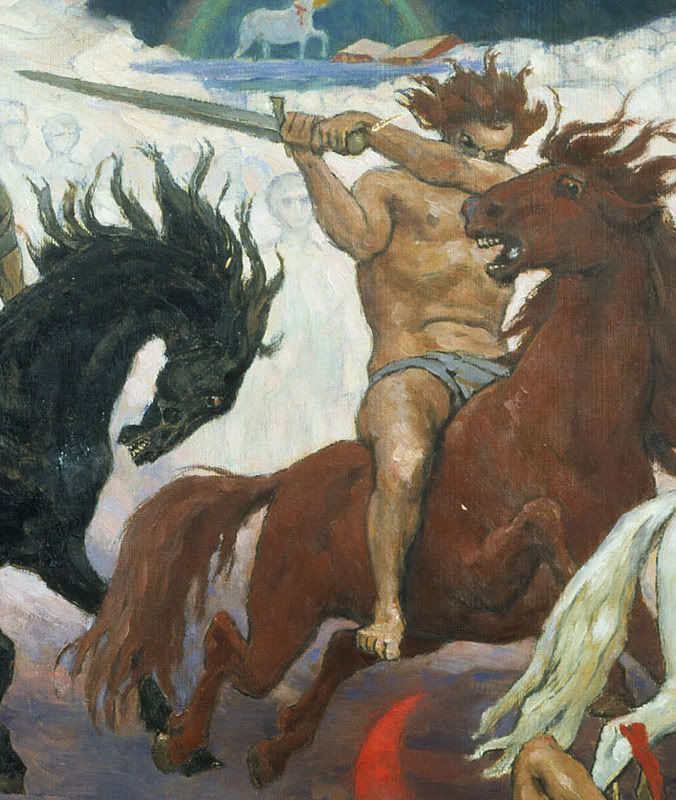
The Second Horseman
When the Lamb opened the second seal, I heard the second living creature say, "Come!" Then another horse came out, a fiery red one. Its rider was given power to take peace from the earth and to make men slay each other. To him was given a large sword.The key words to me are, "take peace from the earth", and "make men slay each other".[Rev 6:3-4]
Then the immediate question is: what is peace?
Now it must be obvious that we do not know this peace as it was taken away from earth, even from long ago, certainly as early as when Cain murdered his brother Abel. On the other hand, we also know that Jesus before he died and resurrected said:
Peace I leave with you; my peace I give you. I do not give to you as the world gives. Do not let your hearts be troubled and do not be afraid.Again what is this peace that Jesus gives?[John 14:27]
To me the peace is this, namely the assurance that God is God, and even sin and death cannot destroy us, even as Jesus demonstrated God's victory over sin and death in his resurrection. Until Jesus there was no certainty that death is not the end, and thus the angst in Ecclesiastes.
But with the certainty and thus our assurance we have no or need not have any more fear of death and it ought not be something that man can exploit to "blackmail" us, ie to induce, compel or coerce us to do things solely to avoid the fear and threat of death.
And that is precisely what the red horseman did: to put upon man himself to use this fear - to make man slay one another - to further his goal of dominance on earth, ie as was introduced by the first horseman.
And this is what we see in the world from the very beginning. And this fear is the very reason armies are effective instruments in this world.
It is also this fear of death that makes us prostitute ourselves, as in compromising our being and selves, for example for the sake of earning money to continue our physical livelihood. And this prostitution is what the third horseman is about.
Sunday, March 16, 2008
The First Horseman
I watched as the Lamb opened the first of the seven seals. Then I heard one of the four living creatures say in a voice like thunder, "Come!" I looked, and there before me was a white horse! Its rider held a bow, and he was given a crown, and he rode out as a conqueror bent on conquest.[Rev 6:1-2]
In various commentaries the rider on the white horse is interpreted as Christ himself. Yet in others he is the anti-Christ.
To me the rider is simple Man himself, but with a crown, representing dominion and authority. And where once the earth was part of the kingdom of God, it is now the kingdom of Man.
And Man is bent on bringing all of earth under his dominion by means of the force of arms as depicted in the bow in his hands.
And so Man usurps the authority of God on earth.
We see the rider on the white horse with a crown and a bow in all the powers, empires, kingdoms and governments in all the countries in the world from the past till today.
And where once people depends on God, now they depend on themselves. Where once people had faith, now they rely on their authority, wit, power, etc, to pursue their own goals, whatever these may be, even if they be meaningless and futile.
And Man is indeed powerful, especially when they are of one heart and one mind, and is capable of many feats and achievements, from the Tower of Babel in the past to the space station today and more beyond.
But Man is not God.
And so this is the first attribute that is painted in the first horseman, namely that the world is faithless, believing in themselves and setting themselves to be God, ie idolatry.
Friday, March 14, 2008
The Four Horsemen of the Apocalypse (Part I)
A necessary element to understand Revelation is having a correct concept of time.
Revelation, the title, connotes an insight into the future. This is indeed true, but it need not suggest that the book was written in any chronological manner.
That one apparent event is mentioned after another, does not mean that event occurs after the latter, if such an event even occurred.
For just as we list the attributes of a thing - in the limitation of the human language - one attribute after another, we are obviously not saying that one attribute is before or after another in time. All attributes exist simultaneously at one time and for all times.
Another example is music.
For even as music is played one note at a time, the essence of the music, as in the drama and the emotions that are heard and felt, are not in time itself; and neither do we hear one note at a time. But we hear music.
So then time can merely be a vehicle for the communication of something eternal and timeless.
And also perhaps the appearance of the horsemen at each opening of the seals need not be chronological events, occurring one after another, but rather are like attributes of a thing, or the notes of a music, as the means to paint a picture.
And so what is this picture painted by the horsemen? What is the essential whole that our imaginations are to see, even as our ears hear music and not individual notes?
That will be answered next.
Thursday, March 13, 2008
What We Know
We also know that we don't know other things.
And we also know that we know only a part - a very small part - of all that is known to humankind, in all the world, for all times.
And we may not know - but we can bet - that there is no one who knows all that is known, even if all known things are written in wikipedia.
But we may know something that the whole wide world don't.
Yes, the probability is very very small, ie very improbable, but it is still very possible, ie not impossible, as that is one way how discoveries and inventions had happened, and will continue to happen.
More fundamentally there are things knowable and things unknowable.
We know these too, and we also know that of things knowable, all may not be known now, even if we know fundamentally that they are knowable.
An example of a thing that is a known unknowable, is the exact position and exact momentum of a particle at any point in time, namely the Heisenberg Principle. This unknowability is a fundamental one in that it is beyond our reasoning and perception, for all efforts, for all time. And of course many people don't know this uncertainty principle, not that it matters to them anyway.
Another known unknowable thing is some aspects of history for which no trace whatsoever survived over time. What is knowable is only whatever perceptible to humans.
And we also know the future is unknowable.
Of the things known to be knowable - or so we think - an example could be all the proteins that the human chromosomes can generate.
Of course there are always things that is unknowable now if it is knowable or not, for example, the question, are we alone in the Universe.
And last, and most intriguingly, is the possibility that a person can know a thing that is unknowable.
How can it be so?
Things knowable are those accessible to our knowledge by means of reason and perception. But certainly there are things inaccessible by mere reason and perception. And so are there other ways of knowing apart from these?
I think there are.
PS: We can summarise all these into a cube with each axis having two values, namely, (Know, Don't Know), (Known, Unknown), and (Knowable, Unknowable).
Tuesday, November 20, 2007
Sunday, September 23, 2007
Image of God
We are made in the image of God as a fractal is an image of the whole, and not as an illusion reflected in a mirror.
A fractal is identical to the whole in every part, but yet it is not the whole.
The whole only becomes when all fractal parts are in the right place altogether.
A fractal is identical to the whole in every part, but yet it is not the whole.
The whole only becomes when all fractal parts are in the right place altogether.
Saturday, September 22, 2007
Prostitution
Prostitution is the compromise of one's integrity, especially in return for something non essential or irrelevant to one's identity.
So to think and see different just for the sake of pleasing the boss or for gain is as much a prostitution as one who sells her body for money.
Esau selling his birth right for a bowl of pea soup is another example.
And Israel was a prostitute too when she compromised her identity, which was essentially derived from a relationship with God, by exploiting worldly relationships instead, such as seeking a king and forming allies.
So to think and see different just for the sake of pleasing the boss or for gain is as much a prostitution as one who sells her body for money.
Esau selling his birth right for a bowl of pea soup is another example.
And Israel was a prostitute too when she compromised her identity, which was essentially derived from a relationship with God, by exploiting worldly relationships instead, such as seeking a king and forming allies.
Tuesday, March 06, 2007
What is Good?
A righteous man cares for the needs of his animal,
but the kindest acts of the wicked are cruel.[Pro 12:10]
And evil is what evil does.
Red Moon
lunar eclipse, originally uploaded by Grzesiek
I watched as he opened the sixth seal. There was a great earthquake. The sun turned black like sackcloth made of goat hair, the whole moon turned blood red ... [Rev 6:12]
Friday, October 20, 2006
Green and Yellow
So what if a blind man cannot tell the difference between a green thing or a yellow thing, and has no idea at all about the concept of colour?
Sure he missed something that normally sighted people has - the experience of the colourful. But so what if he is unable to have such an experience?
It is certainly a different life. But it may not be any less richer. For, as an example, he may have a keener sense of sound and touch compared to sighted people.
And life may not be any less meaningful too. It can even be more meaningful: for life is not merely about things seen but even more so, it is certainly about things unseen, such as love and beauty and joy and fulfillment, and many other things of the spirit, just as life is not merely about food, drink and sex.
For example the things written in this words are entirely spiritual. They are not about things seen or touched or heard. But yet these things may matter more for life than anything seen or touched or heard.
But unless a blind man recognises and accepts that he can never know colour, he may not look elsewhere, and may never see and take this path, and will not even begin to ask the right questions.
If he simply and simplistically just want to have what everyone have in common, and just be like anybody, and be like sighted people, and make a so-called choice to learn about colours, and in desperation even deludes himself that he have learnt it, then he will never come this way, and will never truly learn that life is more than sight and sound and touch.
And he will also never discover his true destiny.
But if he is wise and knows that not all things can be changed or for your choosing, then he may discover a new road and a new way, perhaps, only something that he alone can and must walk.
Maybe he cannot walk it alone. And maybe there is someone waiting to walk with him. But then he is blind.
But if he does come this way - alone or with a partner - then all things are equal - for in a sense everyone is blind spiritually. And then the blind man is no longer any worst off from anyone sighted, and in fact may be even better off, for sight can be a great distraction and even a deceiver.
For things of the spirit are not seen but discerned spiritually without eyes.
And then the blind may truly see, and the sighted are the ones blind.
Wednesday, October 18, 2006
Red and Blue
Can a blind man see?
How many times must a blind man feel a red thing and a blue thing to learn to tell what is red and what is blue?
But one who sees, does not need to feel anything red or blue to know what is red and blue. Feel is irrelevant to knowing colours.
And he does not even need to see what is maroon or mauve or magenta, but just from someone's description of these, he may already be able to recognise them the first time, if he ever sees these colours.
But a blind man will go to his grave not knowing what is red or blue.
And worst he thinks he knows, and has learnt what is red and what is blue.
But the wise blind man knows that he cannot know and will not seek in futility to tell what is red and what is blue.
Monday, October 02, 2006
Ubuntu
It is always very uplifting for me when what I think, or what I know, is affirmed for me in unexpected ways, and without me seeking for it.
And one of these of late is ubuntu.
Of course I didnt know it by that name - its an African word - but to me I have known the same thing conceptually, for some time by now, and arrived at independent of any external influences, ie nothing from what I read, or hear, or what someone tells me, but entirely from internal construction from fundamental truths that I have accumulated.
And this is the analogy of the jigsaw puzzle.
Each of us, as an individual, on our own, is like a jigsaw puzzle, oddly shaped, strangely coloured, and entirely meaningless on its own. It is only when it is fitted with other similarly odd-shaped, and strange-coloured pieces, does it make sense why we are what we are. Then our oddness disappears, and all the colours make sense. And this apply too for every other piece to whom we are attached.
But just as our purpose and meaning hinged on being part of the big picture, the big picture in turn need every single piece to be in place and not missing. It may be a million piece jigsaw puzzle, but yet every single piece is equally and crucially significant. No piece is unnecessary or redundant. Without everyone fitted in place, there is no big picture.
So thats ubuntu for me: others define who you are, just as much as you define who they are. And Bill Clinton puts it, in what I think, equivalent terms, "I am because you are."
And there is an interesting parallel here: When Moses asked God what is His name, God said, "I am I am".
And one of these of late is ubuntu.
Of course I didnt know it by that name - its an African word - but to me I have known the same thing conceptually, for some time by now, and arrived at independent of any external influences, ie nothing from what I read, or hear, or what someone tells me, but entirely from internal construction from fundamental truths that I have accumulated.
And this is the analogy of the jigsaw puzzle.
Each of us, as an individual, on our own, is like a jigsaw puzzle, oddly shaped, strangely coloured, and entirely meaningless on its own. It is only when it is fitted with other similarly odd-shaped, and strange-coloured pieces, does it make sense why we are what we are. Then our oddness disappears, and all the colours make sense. And this apply too for every other piece to whom we are attached.
But just as our purpose and meaning hinged on being part of the big picture, the big picture in turn need every single piece to be in place and not missing. It may be a million piece jigsaw puzzle, but yet every single piece is equally and crucially significant. No piece is unnecessary or redundant. Without everyone fitted in place, there is no big picture.
So thats ubuntu for me: others define who you are, just as much as you define who they are. And Bill Clinton puts it, in what I think, equivalent terms, "I am because you are."
And there is an interesting parallel here: When Moses asked God what is His name, God said, "I am I am".
Monday, September 25, 2006
The B I G Lie
This issue have been like a grain of sand in my shoe. I gnaws at me and I have to do something about it. For I am constantly irritated by the ignorant unthinking acceptance of this lie. This is not my last word but is the most coherent and comprehensive yet.
Life is about choices.
Or is it?
I say that's a big lie.
And I say choice is moot. It is irrelevant. It is an illusion.
There are two categories of choices.
The first is like a multiple choice question, where only one answer is right, or at the least some choices are better than another.
Imagine you tell a student who is preparing for an exam that the exam is in a multiple choice format, and the answer to any question is his choice.
Does that helped him?
Just because the answer is his choice, does it help him to know and to choose the right answer?
The student cannot just choose any answer can he?
And sometimes the answer is none of the above.
What really helps is to teach him to find and to know the right answer.
Telling him he has a choice sounds good but it is really a hollow, empty, and effectively a non-answer at all.
And if he knows the right answer, whether the question has multiple choice answers or not is not really important. It is entirely irrelevant.
And that illustrate what I mean by choice being moot and irrelevant.
There is no need for choices. There is only the need for knowledge and the ability to make or say that correct answer - and we are also able to say what we know is right, don't we?
Choices only matter to those who don't know the answers and having choices may at least give him some chance - ie by sheer luck - of getting some answers right. But that more likely than not will not see him passing the exam.
Choices can also be more harmful than good, eg I know of a better and more precise answer than what the choices are offering me. Think about that.
The other category of choice is where indeed any choice is the answer.
This is the situation where, for example, there is no right answer. But we must ascertain that indeed there is no right answer and any answer will do.
A possible example here is what to eat for lunch. As long as it is food any choice will do.
But if so again why the need for choices?
For have we not sometimes tell others to decide and choose for us, like telling them, "Whatever you buy, buy the same for me."
And the reason why you have to choose in this lunch example, is that the number of food sold in the hawker centre is limited.
So again choice is moot and irrelevant: there is no need for choices: if I have to eat and the only food being sold is nasi lemak, then nasi lemak will do and is good enough.
Sometimes having a surfeit of choices like twenty types of food is a wasteful, unnecessary, irrelevant, over-hyped indulgence. We may be better off without having to make choices in such inconsequential matters and just stick to nasi lemak without any choice.
And also if truly any choice will do, and whatever I choose is the answer, why must I be restricted to choose only from a limited set of possible choices?
And that also illustrates what I mean when I say choice is an illusion.
People, especially the Americans, and other people who don't think, like to portray, even define, freedom as the ability to choose. That is another facet of that big lie.
Choosing means choices, and choices are necessarily restricted and imposed upon you by circumstances outside your control: such as the political parties in authority at the moment, or such as the types and number of food you can buy in the hawker centre.
I rather see true freedom as not being restricted in any way at all, and certainly not to have my choice constrained to just choosing from a limited set of choices.
I rather have the true freedom of having the means and the ability to create my very own unique answer or solution.
I don't need choices. I just need one thing; I need to know what is this one thing I need and have the means to make this one thing happen.
I just need the freedom to say what I want, do I want, eat what I want, etc. I rather be truly free to make an answer - any answer - to any situation, than have a plethora of irrelevant choices. That to me is true freedom!
Choosing means freedom is a most insidious lie!
Politicians give you choices because then they pass the buck to you, and you cannot hold them responsible for whatever that happens to you, because - and all together now - its your choice.
So you had better lived with the outcome and don't bother them with your misery. That is the meaning of choice politically, and we see it happen all the time, eg in the work place.
And it is most prevalent when people who ought to be responsible for you, don't know what is best for you; and instead of determining the best thing for you, give you a set of limited and half-baked options and pass the buck of being responsible for the outcome to you. And your very act of choosing seemingly also imply that you have assume this responsibility for yourself, but which was morally theirs and never transferrable.
So be especially wary when someone tells you, "It's your choice." It means they do not know what's best for you and that you ought not to bother them should it turn out bad for you.
And finally a matter closer to heart. Let me tell you a story about money.
There was a guy, recently working, and has accumulated some balance in his bank, more than he ever had all his life.
Being prudent he wants to make this money grow, at least faster than merely deposited in the bank. And also he has heard a bit of such buzzwords as financial management, financial goals, risk profiles etc etc. And so he starting asking around and started reading, and also some of his friends are in this business of managing other people's money.
And so he got to know such an agent. And the agent said a lot of things, and a lot of ifs and buts too. But the whole thing boils down to choosing between three Funds: Fund A gives you 5% return, Fund B gives you 2% return, and Fund C at the moment is returning 8%.
The agent told him that it is his choice.
But really its a no brainer, right? You can choose with your eyes closed, right?
So he invested in Fund C.
Three months later Fund C went down -10%, Fund B barely moved at 2%, and Fund A returned 10%.
But it was his choice. He cannot blame anyone, especially his agent, and must accept it.
But it made a mockery to his stated goal of financial growth and so on, and all his time and effort spent listening to the agent, and toiling mentally with all the figures and jargon, a futility.
He could have done better doing nothing and leaving the money in the bank and used the time and effort to do more important things. (But again he may not, but just waste it away in another manner.)
On the other hand, he has now taken on a long term perspective.
But really is there any choice?
It is again another no brainer, given what has happened. And also why should things be any different 6 months out, a year out, or even 10 years out? Things are entirely out of his control. His choice makes no difference whatsoever to reality.
And also unbeknownst to both he and his agent, there was Fund D that performed +20% over the same period, and Fund E that gave a guaranteed 8% return.
Maybe he has to choose a better agent next time. But where are these? Who are they? What he knows is what he knows, and what he doesn't he don't.
And of course there may also be Fund F and Fund G and Fund H, etc etc. Some of them are yet to be created or constructed, just because nobody asked for them, for they are customised, specially tailored products.
Then at the same time there was another person. This person has a very strict father. And the father didn't allow him to manage his own funds. The father compel this guy to entrust all his monies to the father, and the father only gives out a regular allowance. This guy had no choice. But 3 months later, the father-managed funds grew 50%.
So what is the morale of this story?
You may object immediately that this is unreal. Such a story is a fairy tale. It does not happen in real life.
Actually that is a valid and acceptable objection.
For in the real world where is there such a father who dare impose his will on his son, and to curtail his son's freedom. And also even if there is one who dares to do so, and has a son who is meek enough to comply, why should just being such a father makes him a better fund manager than other professional fund managers, and that he knows more than those who make a living from selling funds to people?
Where can you find a father that is so wise and knowledgeable that you can indeed entrust your monies entirely and completely to him and just to live on allowances that he doled out?
There are possibilities certainly, like the father owning a stock brokering firm, or George Soros himself. I do in fact know of an owner of a stock brokering firm in Singapore, but for him to be my father is another matter altogether. So the chances of you or anyone having such father is probably less probable than winning Toto, or the earth being hit by an asteroid in the next year.
So for the ordinary mortal, such are the stuff of fairy tales.
But on the other hand, you cannot deny that Funds going up and down are not a reality.
In fact every funds have it in fine print, that past performances are no guarantee for future ones. Yet everyone look at past performances to decide which is the "better" fund. In part there is no choice about it - and there is more than a tinge of irony here - for no one knows the future. And that is really why people give you choices: you have no choice but to choose.
Your greater need are thus not choices but more to know how to seek that one fund, or some other means and instrument, that will meet your financial goals and objectives, or that person who knows.
But then who knows? There will be no one who dare to tell you to invest in a specific and particular fund or funds. It may be -5% last year, but in 10 years it will be +1500%. Who knows? Not unless he or you have a time machine and have gone into the future and seen what things will be like.
So what is the alternative to this lack of knowledge?
We have all heard it before: so, all together now ...
"Its Your Choice!"
Sunday, September 03, 2006
Reaching God
It is oft said that there are many ways to God, but it is apparently unknown that religion is certainly not the way.
Tuesday, August 15, 2006
Faith, Unfaithfulness and Faithlessness
Faith is being assured of a true thing, that you can believe it, even to depend and act on it.
Faith is belief put into action.
It is like being assured that a parachute works and you are willing to and indeed do jump off aircraft with merely a parachute.
Unfaithfulness is being assured too, but seemingly so only, as you would not make that leap.
Faithlessness is not even believing in such a thing as a parachute.
Of unfaithfulness and faithlessness, the former is the more grievous sin.
In some ways it is better not to know, then to know and not believe. You are accountable for all that you know.
But you may think you know. And then there are also different types of faith.
Some believe for one reason or another - or none at all other than their own strength of belief - that they can fly and need no parachute, for example.
And some do indeed are so assured as to jump off aircraft without parachutes. Or fly aircraft into buildings.
But there are truths. No amount of self-will, or self-belief, can make gravity go away for instance.
If something is not, and never will be, the strength of your belief or persistence of your will, will not change anything. In fact they are entirely irrelevant.
Self belief can easily be self-delusion. And they are all kinds of false faith.
True faith is not founded upon your capability of belief or of its strength thereof. Rather it is knowledge of the truth and acting upon it.
And if the truth be true indeed, then faith leads to more knowledge and more knowledge to more faith, and thus faith grows from faith to faith.
It is like seeing a chair in a room. If by believing it, you sit in it, then you will come to know of something as comfort, the very essence of a chair; for a chair is not about four legs and so on, but of the restfulness that its gives.
And all these you cannot comprehend by merely being convinced, no matter how strongly, of the mere concept of thing with four legs called a chair.
And remaining aloof and detached will evidenced itself as unfaithfulness when you need rest but you yet refuse to sit in the chair.
Faith is belief put into action.
It is like being assured that a parachute works and you are willing to and indeed do jump off aircraft with merely a parachute.
Unfaithfulness is being assured too, but seemingly so only, as you would not make that leap.
Faithlessness is not even believing in such a thing as a parachute.
Of unfaithfulness and faithlessness, the former is the more grievous sin.
In some ways it is better not to know, then to know and not believe. You are accountable for all that you know.
But you may think you know. And then there are also different types of faith.
Some believe for one reason or another - or none at all other than their own strength of belief - that they can fly and need no parachute, for example.
And some do indeed are so assured as to jump off aircraft without parachutes. Or fly aircraft into buildings.
But there are truths. No amount of self-will, or self-belief, can make gravity go away for instance.
If something is not, and never will be, the strength of your belief or persistence of your will, will not change anything. In fact they are entirely irrelevant.
Self belief can easily be self-delusion. And they are all kinds of false faith.
True faith is not founded upon your capability of belief or of its strength thereof. Rather it is knowledge of the truth and acting upon it.
And if the truth be true indeed, then faith leads to more knowledge and more knowledge to more faith, and thus faith grows from faith to faith.
It is like seeing a chair in a room. If by believing it, you sit in it, then you will come to know of something as comfort, the very essence of a chair; for a chair is not about four legs and so on, but of the restfulness that its gives.
And all these you cannot comprehend by merely being convinced, no matter how strongly, of the mere concept of thing with four legs called a chair.
And remaining aloof and detached will evidenced itself as unfaithfulness when you need rest but you yet refuse to sit in the chair.
Friday, March 24, 2006
The Boss is Right
The boss is right.
And it seems we are wired for this.
And it may well be true.
But the trouble is we may not know
who is the right boss.
Also we prefer certainty and stability
over uncertainty and change.
Again it is seemingly something natural in us.
And again there may be nothing wrong,
but in fact even a right thing to cling to the certain.
But the trouble is we just cling to anything,
even something of our own creation.
What the boss says is true.
And he has the resources, authority and influence to make it so.
And we run the peril of being denied resources if we disagree,
and be compelled or persuaded to agree.
But the trouble is no boss has any monopoly on what is true.
And it seems we are wired for this.
And it may well be true.
But the trouble is we may not know
who is the right boss.
Also we prefer certainty and stability
over uncertainty and change.
Again it is seemingly something natural in us.
And again there may be nothing wrong,
but in fact even a right thing to cling to the certain.
But the trouble is we just cling to anything,
even something of our own creation.
What the boss says is true.
And he has the resources, authority and influence to make it so.
And we run the peril of being denied resources if we disagree,
and be compelled or persuaded to agree.
But the trouble is no boss has any monopoly on what is true.
Tuesday, March 14, 2006
Why Say So
Why say come to church?
Why not be the church wherever and whenever you are, for wherever and whenever two or three are gathered in God' s name there is God in your midst, and you and the Holy Spirit are two.
Why say Lord I submit my plans to you?
Why not fear the Lord and surrender yourself to his plans for you, even if you do not know and cannot see what it is. You may have planned to save your money for that investment opportunity you can see coming soon, but there is your neighbour, here and now, who needs that money for his medical bills, and we all know that Jesus said love your neighbour.
Why say God is love, when you can love and show that God is.
Why not be the church wherever and whenever you are, for wherever and whenever two or three are gathered in God' s name there is God in your midst, and you and the Holy Spirit are two.
Why say Lord I submit my plans to you?
Why not fear the Lord and surrender yourself to his plans for you, even if you do not know and cannot see what it is. You may have planned to save your money for that investment opportunity you can see coming soon, but there is your neighbour, here and now, who needs that money for his medical bills, and we all know that Jesus said love your neighbour.
Why say God is love, when you can love and show that God is.
Monday, March 06, 2006
Snippets
Fortune Tellers: Saw two of them asking people to have their fortune read during lunch at a coffee shop. If they can tell others' fortunes, could they not foretell their own, and know who needs fortune telling, for isnt such where their own fortunes lie?
Truth: It is seemingly politically incorrect now to say that there is absolute truth, or even that there are right and wrong things, for to say so implies there are also absolute lies, and it makes some to be liars and some to be believers of such lies, and that make these people unhappy, and it is disrespectful and insensitive to make people unhappy.
Idolatry: People say they go to church to worship God, but really they go to church to hear things that make them feel good and exalted, ie they seeked to be worshipped instead.
Unfaithfulness and Faithlessness: The former knows the truth but do not conform to it, the latter don't believe in such as truth.
Truth: It is seemingly politically incorrect now to say that there is absolute truth, or even that there are right and wrong things, for to say so implies there are also absolute lies, and it makes some to be liars and some to be believers of such lies, and that make these people unhappy, and it is disrespectful and insensitive to make people unhappy.
Idolatry: People say they go to church to worship God, but really they go to church to hear things that make them feel good and exalted, ie they seeked to be worshipped instead.
Unfaithfulness and Faithlessness: The former knows the truth but do not conform to it, the latter don't believe in such as truth.
Friday, February 10, 2006
Hypocrisy
" ... They spit on him, and took the staff and struck him on the head again and again. After they had mocked him, they took off the robe and put his own clothes on him. Then they led him away to crucify him." [Matt 27:30-31]What would a peaceable man do if he is insulted?
Destroy? Burn? Kill?
Are we what we do, and not what we - and others - say we are?
And is the insult really an insult?
For is not the current behaviour simply proving that the insults are not, but rather truths?
Even if it is truly insulting, is the mad fury, the blind, unmitigated and rampant violence and terror, ever an appropriate response?
For even if justice is based on an eye for an eye, a tooth for a tooth, the most that is justifiable - in any circumstances - is to trade insults for the perceived ones: a hurt feeling for a hurt feeling.
And is any insult so injurious and damaging, that any and every act is justifiable?
It is beyond imagination to think that riots, destruction and killing - accidentally or otherwise - are appropriate or proportional, the usual measures of just responses.
To be sure feelings are important, and people can and will die for what they feel. Feelings can move you to move mountains and swim oceans, and it is oft quoted that a scorned woman's fury is unknown in hell. But does not such willingness to wreck destruction, and even to die, for a dead man's image and name, borders on idolatry itself, something supposedly abhorred by these rioters?
Is it insulting to call someone hypocrite?
Of course I can lie or I can be wrong and mistaken. But what if it is true, that you are indeed one? Can a truth ever be insulting?
Sure I can say it differently, with or without considerations for your sensitivities, and again intentional or not. Your feelings may be hurt, but that's a different question from me being insulting.
I can speak kindly but you feel hurt, and conversely, I can intentionally speak to hurt, but you are entirely indifferent.
For if I speak or do things to you that are beneath your position or your stature does it diminish or change whatever your position or stature may be? If someone calls me a pig in anger, I can only find it amusing, and, to me, reveals his wits, or lack thereof.
And if my insult is based on a lie, is not the best response to expose my lie, especially if you demonstrate in your acts, peaceably, peacefully and incontrovertibly, that I am a liar, and not merely rant and rage and shout at me as a liar?
But if it is not a lie, even if my intention is to hurt your feelings, is it not for your good to know that the emperor has no clothes?
Or you rather continue in the comfort of your delusionary clothes, even to deny and forcibly and furiously suppress my right to say what I see and think?
Sure no rights are absolute. And my freedom to choose is curtailed to the extent it affects someone else's choices and being.
But should there ever be any restraint on truth itself? Or would you rather I not speak what I think and know to be true, but rather always concur, or at the least pretend to concur, with what to me is a lie or an untruth?
We, as fallible humans, are always vulnerable and susceptible to be wrong, and to believe a lie, and therefore should we not always welcome to be corrected and not to fall into a lie?
But on the other hand, if someone calls us a liar, because we are one, and he has found that out, then it will be our great concern that he holds such knowledge, ie if we want to continue to lie.
And then we are compelled to take appropriate actions to prevent and discourage him, and others, from knowing that truth. And certainly strong and vigorous actions, and not merely retort in words - or silence - are called for. And the more vigorous and more violent the response is, the more the better to deter and discourage, if not to entirely dispel, the knowledge of truth.
And so wisdom - or its lack - is proven by her actions.
Subscribe to:
Posts (Atom)